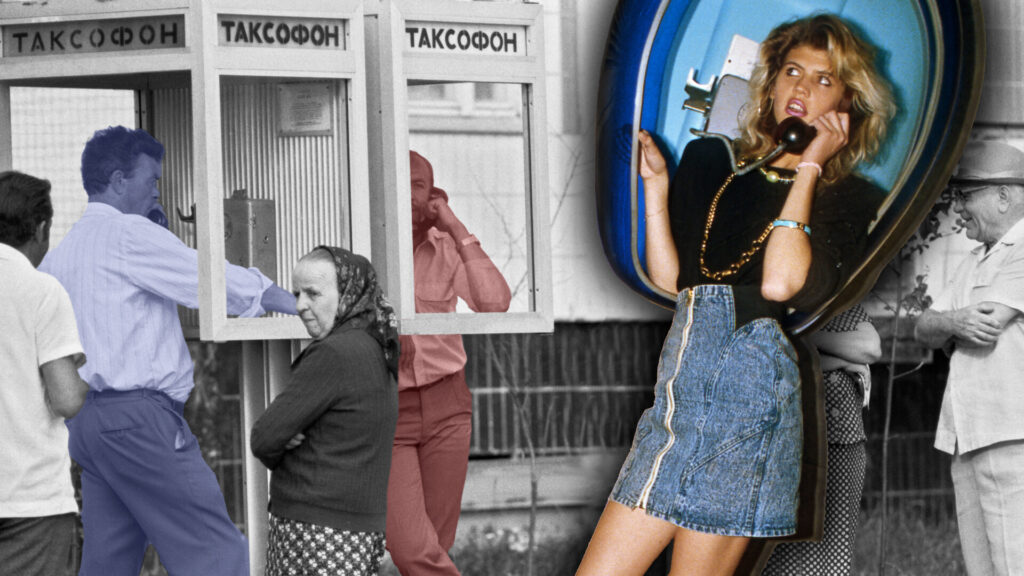
In 1974, a Moscow physicist named Viktor needed to call his brother in Leningrad about something he didn’t want the KGB to hear. He didn’t use his home phone — he walked 20 minutes to a specific public booth on Kutuzovsky Prospekt, one that an engineer friend had told him “wasn’t on the list yet.”
That walk — 20 minutes to a number that wasn’t really his — is, structurally, the same thing you do today when you paste someone else’s phone number into a sign-up form. The tools changed. The instinct didn’t.
This is a short history of people who needed a phone number that wasn’t theirs, and what it tells us about the thing we’re all quietly building now.
The Vertushka and the Shadow Network: How the USSR Accidentally Built the First Privacy Layer
The Soviet telephone system contained a paradox. At its apex sat the Vertushka — ATS-1 and ATS-2, the Kremlin’s closed, encrypted government-only networks with approximately 2,000 subscribers at peak. These lines were physically separate from the civilian network. No public directory existed. Numbers were assigned by KGB clearance level. Access to the Vertushka was itself a form of power — a way of saying: I am someone whose communications matter.
Ordinary citizens, meanwhile, knew that the regular city telephone network — the ATS — was routinely monitored. The 8th Chief Directorate of the KGB was responsible for communications security and monitored an estimated several hundred thousand civilian phone lines in Moscow alone by the late 1970s.
What emerged between these two systems was something nobody designed: an informal third network.
Dissidents and journalists passed around the addresses of specific public payphones known as “clean” — not yet bugged, or too low-priority to bug. University department lobby phones, registered to institutions rather than people, became informal conduits. Communal apartment phones, where the line was registered to a neighbor rather than the caller, became a kind of unintentional privacy layer.
The logic was simple and ancient: a phone number tied to your identity is a liability. Every time in history a communication system has been coupled to identity, a parallel system has sprung up next to it. Not invented by bad people. Invented by everyone.
Viktor’s 20-minute walk to a payphone “not on the list” was not an act of espionage. It was an act of ordinary caution by an ordinary man inside an extraordinary surveillance system. The extraordinary part was the system, not the man.
Sources
- Steven J. Main, The Soviet High Command and the Uses of Communications, 1941–1991, Journal of Slavic Military Studies — on the Vertushka subscriber count and KGB clearance access structure.
- Christopher Andrew & Vasili Mitrokhin, The Sword and the Shield: The Mitrokhin Archive and the Secret History of the KGB (1999) — on the 8th Chief Directorate’s civilian monitoring scope.
The New York Payphone, the German C-Netz Card, and the 90s Call-Shop: The West Had the Same Instinct
It would be easy to frame the Soviet story as specific to authoritarianism — a product of paranoia under a particular regime. But the same pattern runs through every liberal democracy that built a telephone system large enough to matter.
In 1980s New York, journalists covering organized crime used specific payphones in Grand Central Terminal whose numbers they gave to sources. Bob Woodward’s famous parking garage meetings with Deep Throat were, functionally, a location-based anonymous telephone call — the meeting point was chosen because it couldn’t be observed, and the information exchanged there couldn’t be traced back through a phone record. The instinct was identical to Viktor’s.
In 1990s Germany, the C-Netz prepaid card, launched approximately 1992 by DeTeMobil, became the first mass-market anonymous mobile number in Europe. It sold approximately 800,000 units before mandatory registration laws closed the loophole in the 2000s. People bought it not because they were criminals but because the alternative — a name-linked contract — felt like something the state didn’t need to have.
In immigrant neighborhoods from Queens to Kreuzberg to Southall, the call-shop booth ecosystem gave millions of people a phone number that wasn’t theirs, for a few dollars an hour. The booth number appeared on the recipient’s screen. The caller’s real number stayed private. This was not a gray-market product — it was a grocery-store-adjacent service used by people who wanted to call home and didn’t want their number on a list someone would sell.
Which brings us to a man who, in 2024, listed a used laptop on Craigslist with his real phone number and received 40 calls in three days — from resellers, fake “sheriffs,” and scammers. His problem was structurally identical to the 1990s immigrant calling home about a job: I don’t want my number on a list someone will sell. The solution has always been the same: route through something that isn’t you.
Sources
- Bundesnetzagentur historical reports; industry retrospectives on Mobile Communications in Germany 1990–2005 — on C-Netz prepaid unit sales and registration timeline.
- FCC, Trends in Telephone Service (2005, 2018, 2022) — approximately 2.1 million U.S. payphones in 2005; fewer than 100,000 by 2022.
The Moment the Phone Number Became an ID — and Why No One Noticed
Somewhere between 2009 — the year WhatsApp launched and used a phone number as its primary login — and 2016, when mass SMS two-factor authentication became a standard security requirement across the internet, the phone number quietly stopped being a way to reach you and became an identifier for you.
This was never announced. No legislation passed. No design review was published. It was a side effect of consumer apps wanting to reduce sign-up friction. Email verification required clicking a link. SMS verification required owning a phone. Since almost everyone already owned a phone, the number became the verification shortcut — and then, gradually, the primary identity key.
The consequences compounded silently. Today, a leaked phone number can resolve — through data broker aggregation — to a full name, address history, employer, family members, and political donation records. Research by Justin Sherman at the Duke Sanford Cyber Policy Program documented that data brokers sell phone-number-linked profiles including location history and household members for as little as $0.006 to $0.05 per record — often less than what a single SMS verification costs in reverse.
The breach record is illustrative. Have I Been Pwned, as of 2024, indexes approximately 12 billion compromised accounts. Phone numbers appear as a leaked field in some of the largest breaches in history: 533 million Facebook accounts in 2021, over 200 million Twitter accounts in 2022, 73 million AT&T records in 2024.
A user reading a headline about “70 million leaked phone numbers” and recognizing their number in a service they barely remember signing up for is experiencing something specific: the realization that a throwaway interaction from a year ago has a permanent address attached to it. The number wasn’t theirs in any meaningful sense — they just typed it into a field. But the data broker doesn’t know that. The data broker has a spreadsheet, and the spreadsheet has a key, and the key is a string of ten digits that resolves to a person.
The “phone number equals your identity” premise was never a considered design choice. It was a side effect of WhatsApp and Uber not wanting the friction of email verification. We are all living inside a UX shortcut from 2011.
Sources
- Justin Sherman, Duke Sanford Cyber Policy Program, Data Brokers and Sensitive Data on U.S. Individuals (2021) — on broker pricing for phone-number-linked profiles.
- Troy Hunt / haveibeenpwned.com public breach index — on breach scale and phone number as a commonly leaked field.
What the Soviet Engineer and the Craigslist Seller Have in Common (and Why the “Multi-Account Guy” Is a Red Herring)
The public image of virtual phone numbers is dominated by one loud minority: the affiliate marketer running 200 TikTok Ads accounts simultaneously, the bot farmer, the gray-hat operator who needs to appear as several different humans at once. This is a real category. It is also a small one — and its noise drowns out the actual signal.
Pew Research Center’s 2023 survey on privacy found that approximately 71% of Americans are concerned about how companies use their data, up from 53% in 2019. Only 16% had taken any concrete step to limit phone-number exposure. That gap — between concern and action — exists not because people don’t care, but because the tools available to them have historically been bad, confusing, or associated with the affiliate-marketer stereotype.
The largest and fastest-growing cohort of virtual number users is not the multi-account operator. It is the person doing exactly what the Moscow engineer did: someone with nothing to hide, who simply doesn’t want their name on a list the data broker is compiling.
Consider the man who installed a browser extension called Honey — a legitimate coupon-finding tool — and, three days later, found his phone exploding with “pre-approved loan” spam calls. He had signed up for Honey with his real number. Honey’s data-sharing agreements were disclosed in a terms of service he did not read, in a section that referenced third-party marketing partners he had never heard of. He is not a fraudster. He is a tired person who learned, the hard way, that a phone number entered into a sign-up field is not a communication choice. It is a business decision — his, made on behalf of someone else, without his full understanding of the consequences.
The “shady” tool — the disposable number, the virtual SMS — is actually the most mainstream privacy instinct humans have ever had. Viktor had it. The Kreuzberg call-shop customer had it. The Honey-spam victim has it. The tool is not the anomaly. The surveillance infrastructure that made the tool necessary is the anomaly.
Sources
- Pew Research Center, Americans and Privacy (2023) — on the gap between privacy concern and concrete protective action.
The Four Kinds of “Number That Isn’t Yours” — and Why Most of Them Are Bad
There are, in 2026, four practical ways to get a phone number that is not your primary registered number. Understanding the differences matters, because they are not interchangeable — and the category has a reputation problem that comes largely from its worst implementations being the most visible ones.
Free public receive-SMS sites
These are websites that list publicly accessible temporary phone numbers and display all incoming SMS messages to anyone who visits the page. They are free. They are also, functionally, already burned. Used by millions of people simultaneously, these numbers are blocked on every major platform that has ever faced sign-up abuse — WhatsApp, Telegram, Google, Meta. More critically: because all incoming messages are public, they are actively exploited for account hijacking via SMS password-reset flows. Using one is not just ineffective; it is potentially dangerous.
VoIP numbers (e.g., Google Voice)
Voice-over-IP numbers offer a real number tied to an internet connection rather than a SIM card. The problem is detection: WhatsApp, Telegram, most banks, and most ride-sharing and gig-economy platforms actively screen against VoIP number ranges and reject them during SMS verification. Google Voice specifically requires an existing U.S. phone number to set up and is unavailable outside the United States. It is a useful tool for specific secondary-number use cases but does not solve the core verification problem.
Prepaid burner SIMs
As of 2024, approximately 157 countries require government-issued ID for prepaid SIM registration, up from 54 countries in 2012. The “anonymous burner SIM” is, as a mainstream option, effectively dead everywhere except a handful of jurisdictions. Where it remains available without ID, it requires physical presence, cannot scale past one number, and costs several dollars minimum — an impractical solution for someone who needs to sign up for a coupon site and doesn’t want to deal with the consequences.
Disposable or rented virtual numbers from a verification service
This is the only category that maps to the actual range of needs without the deficiencies of the other three. A disposable activation number — used once to receive a single SMS, then discarded — costs as little as $0.05 for a low-demand service. A rented number, valid for 30 to 90 days, can receive multiple messages and can be used as a real secondary number for a Craigslist listing or a second WhatsApp account.
What distinguishes a functional version of this category from a bad one: a transparent company with public pricing, clear separation between one-time activation and rental, working numbers across 200+ countries and 1,000+ services, and — the thing almost no one in this space says out loud — an explicit public statement of what the tool is for and what it is not for.
Sources
- GSMA, Mandatory Registration of Prepaid SIM Cards (latest edition) — on the expansion of SIM registration requirements from 54 countries in 2012 to approximately 157 countries by 2024.
The Honest Taboo: A Privacy Tool Is Not an Anonymity Tool
Here is the thing the entire virtual-number category refuses to say out loud, because saying it honestly is also the only thing that gives it legitimate standing.
A virtual number does not make you anonymous.
The service that provides the number knows your IP address, your payment method, and your usage pattern. That information exists, is retained according to a privacy policy, and could be subject to legal process. This is not a failure of the product. It is the nature of any service that operates on the internet.
What a virtual number does — and what it does extremely well — is sever the link between your identity and the specific website or app you are signing up for. That is a more limited claim than anonymity. It is also a more useful one in practice.
The distinction matters. When Honey or any data broker acquires your information, they are not learning “a user who bought a vacuum.” They are learning “Dmitry Ivanov, 33, Brooklyn, who bought a vacuum, registered at three gambling sites, signed up for two loan comparison services, and uses the same email address across all of them.” The linkage is the product. The phone number is the key that enables the linkage.
A virtual number breaks that key for any given sign-up. The broker can still learn that someone signed up using that number. They cannot learn it was Dmitry. That is the actual product category — not “anonymity,” not “ban evasion,” but a privacy layer, in precisely the sense that the Moscow payphone was one: it doesn’t hide you from the state, it hides you from the store clerk.
The EU’s e-Privacy Directive (Directive 2002/58/EC) explicitly distinguishes between identification and contactability — a legal framework that acknowledges you can be reachable without being identified. That is the gap virtual numbers fill. It is a gap that has existed in every communication system since the first switchboard, and that humans have always found informal ways to exploit when the formal system didn’t provide it.
Viktor in 1974. The Kreuzberg call-shop user in 1994. The Honey-spam victim in 2024. They are all, structurally, doing the same thing. The infrastructure has finally caught up to the instinct. The walk is 20 seconds now, not 20 minutes. The principle is identical.
Conclusion: The Instinct Is Older Than the Internet
There’s a reason the “privacy tool” category feels shady even when it shouldn’t: we inherited a 15-year accident — phone number as identity — and then shamed the people who pushed back against it.
But the pattern is older than the internet. Every time a communication system has been coupled to identity, humans have built a quiet parallel layer next to it. The Moscow payphone. The Queens call-shop. The prepaid C-Netz card. The virtual SMS number in your browser tab.
The tool doesn’t make you suspicious. The tool makes you, finally, a normal citizen of a system that forgot to ask whether it should know your name.
Where to Go From Here
If you want to see what a mature version of this category looks like — a transparent company, public pricing, one-time activations from $0.05, rentals up to 90 days, a catalog of 1,000+ services across 200+ countries, and a stated position of “private registration, not ban evasion” — SMStoProxy is the reference we would point you to.
No sign-up is required to browse the catalog. Treat it as research first. Decide later whether you are the Moscow engineer or just tired of the Honey spam. Either way, the instinct is the same.